
Savitribai Phule Pune University (SPPU) – Law


Description
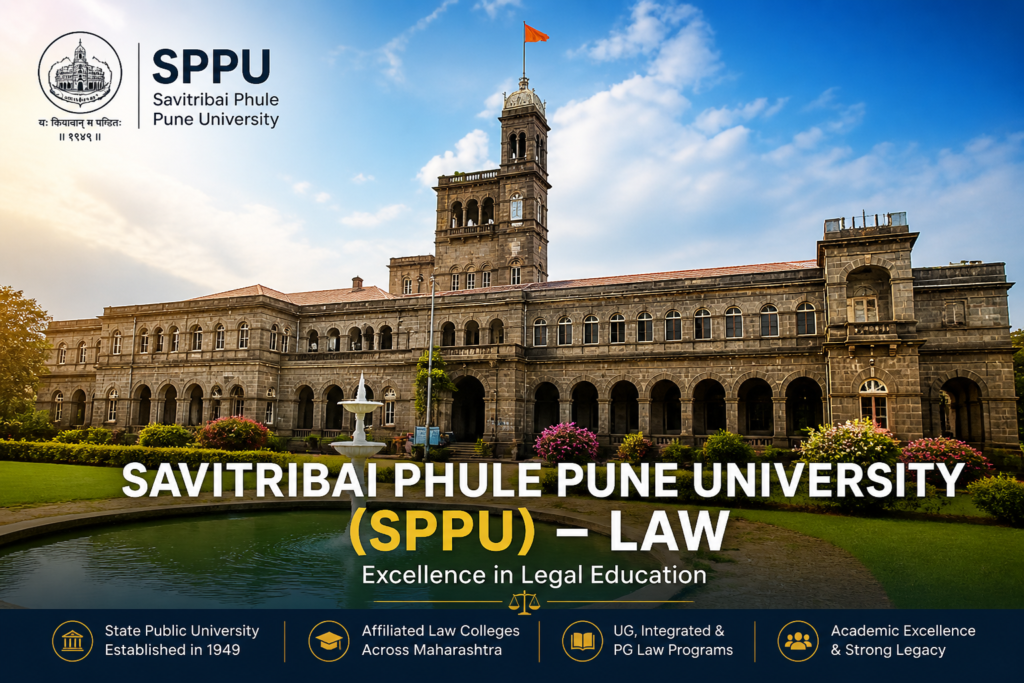
About Savitribai Phule Pune University (SPPU), Pune
Verified by Lawsection.in Editorial Team | Updated: July 23, 2026
Savitribai Phule Pune University is one of India’s leading public universities, widely recognised for its academic excellence, research output, and long-standing institutional legacy. Established in 1949, the university has consistently contributed to higher education across multiple disciplines, including law.
Importantly, SPPU does not operate as a standalone National Law University. Instead, it delivers legal education primarily through its affiliated law colleges across Pune and other parts of Maharashtra, while also offering postgraduate legal studies through its university department and select institutions.
Moreover, undergraduate and integrated law programmes under SPPU are offered through affiliated colleges approved by the Bar Council of India (BCI), wherever applicable. Consequently, graduates may pursue careers in litigation, corporate law, legal consultancy, legal research, academia, and judicial services, subject to the applicable eligibility requirements.
University Snapshot
Location
Pune, Maharashtra, India
Established
1949
Type
State Public University
Law Education Model
Affiliated Law Colleges + Department of Law (Postgraduate & Research Programmes)
Regulatory Framework
Bar Council of India (via approved affiliated colleges)
Official Website
https://beta.unipune.ac.in/
Admission Authority (UG Law)
Maharashtra State CET Cell
Main Intake
As per CET Cell and university academic schedule
Law Programmes Offered under SPPU
SPPU follows a multi-tier legal education structure, offering undergraduate, integrated, and postgraduate programmes through affiliated colleges and university departments.
LL.B (3-Year Programme)
Duration: 3 Years
Eligibility: Graduation in any discipline
Admission: MH CET Law + Centralised Admission Process (CAP)
B.A. LL.B / B.B.A. LL.B (Integrated Programmes)
Duration: 5 Years
Eligibility: 10+2 with minimum qualifying marks
Admission: MH CET Law (primary pathway)
LL.M (Postgraduate Programme)
Duration: As per the prevailing university regulations and applicable academic framework
Eligibility: LL.B degree with the minimum qualifying marks prescribed under the applicable admission notification
Admission: As per the admission process notified by Savitribai Phule Pune University
Note: Eligibility criteria, admission procedures, intake, and other requirements may vary depending on the applicable admission notification, affiliated institution, and prevailing regulatory guidelines.
Law Admission Process at SPPU
Admission to law programmes under SPPU is conducted through a centralised and regulated system:
- Register for MH CET Law
- Appear for the entrance examination
- Participate in the Centralised Admission Process (CAP) conducted by the Maharashtra State CET Cell
- Select preferred SPPU-affiliated law colleges
- Complete document verification
- Confirm admission through fee payment
For LL.M. and other postgraduate law programmes, candidates should follow the admission notifications issued by Savitribai Phule Pune University.
Final admission is subject to seat allotment, document verification, and regulatory compliance.
Top Law Colleges Affiliated with Savitribai Phule Pune University
Savitribai Phule Pune University has a wide network of affiliated law colleges, particularly concentrated in Pune. Some of the prominent law colleges affiliated with Savitribai Phule Pune University include:
- ILS Law College
- DES Shri Navalmal Firodia Law College
- Progressive Education Society’s Modern Law College
- Sinhgad Law College
- Marathwada Mitra Mandal’s Shankarrao Chavan Law College
These colleges offer undergraduate and integrated law programmes under the academic framework of SPPU.
Note: Admission to these colleges is conducted through the MH CET Law Centralised Admission Process (CAP). Affiliation status, course availability, and intake capacity may vary. Candidates are advised to verify details from official college websites and admission authorities.
Why SPPU for Law is Different
SPPU stands apart from standalone law universities due to its affiliation-based academic ecosystem. Instead of a single-campus model, the university provides access to multiple law colleges, each offering varied academic environments and opportunities.
Furthermore, the university emphasises:
- Standardised curriculum across affiliated colleges
- Academic framework implemented in accordance with applicable university regulations
- Strong foundation in core legal subjects
- Integration of theoretical learning with practical exposure
As a result, students benefit from a broad and flexible legal education framework.
Recognition and Institutional Status
Savitribai Phule Pune University holds a well-established position in Indian higher education. Key recognition aspects include:
- Established under state legislation as a public university
- Recognised by the University Grants Commission (UGC) under the applicable provisions of the UGC Act
- Undergraduate and integrated law programmes are offered through affiliated colleges approved by the Bar Council of India (BCI), wherever applicable
- One of India’s oldest multidisciplinary universities
- Known for its extensive affiliating network, academic excellence, and research contributions
Faculty, Academic Framework and Learning Environment
SPPU maintains academic standards through:
- Structured curriculum in accordance with applicable university regulations
- Qualified faculty across the Department of Law and affiliated institutions
- Continuous evaluation through internal and external assessments
- Practical exposure via moot courts, internships, and legal aid activities
Additionally, many affiliated colleges organise seminars, workshops, and court visits, enhancing real-world legal understanding.
Why Students Choose SPPU for Law
Students choose SPPU for several practical and academic reasons:
- Wide availability of law colleges across Pune and Maharashtra
- Structured admission pathway through MH CET Law
- Law programmes offered through BCI-approved affiliated colleges satisfy the academic qualification requirements for enrolment as an advocate in accordance with the applicable rules of the Bar Council of India
- Relatively cost-effective public education model
- Balanced academic learning and practical exposure
Moreover, SPPU is particularly suitable for students seeking accessible and recognised legal education within a regional framework.
Rankings and Reputation
SPPU maintains a strong academic reputation at both national and international levels. While it is not ranked as a law-specific standalone institution, its overall university performance reflects its stature.
- The university has been recognised in various national and international university rankings over the years, including NIRF and QS, depending on the applicable ranking cycle.
- Rankings may vary by year, category, and methodology
Note: Applicants should refer to the latest official NIRF, QS, or other recognised ranking publications for the most recent rankings.
Documents Required for Law Admission
Applicants may generally be required to submit the following documents, subject to the applicable admission notification:
- 10th and 12th mark sheets
- Graduation certificate (for LL.B / LL.M)
- MH CET Law scorecard
- Valid ID proof
- Passport-size photographs
- Category certificate (if applicable)
- Migration certificate (if required)
Students should keep both original and scanned copies ready for verification.
Best Law Universities and Colleges in Maharashtra
Students planning to pursue legal education often compare multiple universities before making an admission decision. Those considering admission to Savitribai Phule Pune University (SPPU) may also compare other recognised law universities and colleges across Maharashtra based on their preferred programme, academic interests, career aspirations, and long-term professional goals.
Law universities and colleges differ in their institutional status, admission procedures, programme offerings, faculty expertise, research opportunities, moot court activities, campus facilities, fee structure, and career support. Therefore, applicants should compare these aspects carefully before selecting a law institution that best aligns with their academic and professional goals.
Savitribai Phule Pune University delivers legal education primarily through its Department of Law and a large network of affiliated law colleges across Pune and other parts of Maharashtra. While the university department mainly focuses on postgraduate studies, research, and advanced legal education, undergraduate and integrated law programmes are offered through BCI-approved affiliated colleges operating under the university’s academic framework. This affiliation-based model enables students to pursue recognised legal education through affiliated law colleges operating under the university’s academic framework.
Located in Pune, one of India’s prominent higher education centres, SPPU offers students access to a vibrant academic ecosystem. Through its Department of Law and affiliated colleges, students may have access to legal research, moot court activities, internships, legal aid initiatives, seminars, workshops, and practical legal learning, depending on the opportunities available at the respective department or affiliated institution.
However, applicants should always compare the latest eligibility criteria, admission procedures, programme structure, fee details, faculty profile, research opportunities, infrastructure, placement support, and Bar Council of India (BCI) approval (where applicable) before making their final admission decision.
Leading Law Universities and Colleges in Maharashtra
| Law University / College | Highlights |
|---|---|
| Savitribai Phule Pune University (SPPU), Pune | Leading public university offering postgraduate legal education through its Department of Law and legal education via a large network of affiliated law colleges across Pune and Maharashtra. |
| Government Law College (GLC), Mumbai | One of India’s oldest law colleges, known for its distinguished academic legacy, strong alumni network, and extensive moot court and litigation exposure. |
| Maharashtra National Law University (MNLU), Mumbai | National Law University offering integrated law programmes, LL.M., Ph.D., interdisciplinary legal education, and advanced legal research opportunities. |
| ILS Law College, Pune | Well-established law college offering undergraduate, postgraduate, diploma, and research programmes with a strong emphasis on practical legal training. |
| Symbiosis Law School, Pune | Constituent institution of Symbiosis International (Deemed University) offering integrated law programmes, LL.M., research opportunities, and interdisciplinary legal education. |
| University of Mumbai – Department of Law, Mumbai | University department offering postgraduate legal education, doctoral research, and specialised legal studies, while undergraduate legal education is delivered through affiliated law colleges. |
| Dr. Babasaheb Ambedkar Marathwada University (BAMU) – Department of Law, Chhatrapati Sambhajinagar | Public university offering postgraduate legal education, doctoral research, diploma programmes, and legal education through affiliated colleges across the Marathwada region. |
| Rashtrasant Tukadoji Maharaj Nagpur University – Department of Law, Nagpur | Public university department providing postgraduate legal education, research programmes, and legal studies through affiliated institutions. |
Other Leading Law Universities in India
Students interested in pursuing legal education, postgraduate studies, judicial services preparation, litigation, corporate law, legal research, or academia may also consider institutions such as:
- National Law University Delhi (NLU Delhi)
- Indian Law Institute (ILI), New Delhi
- National Law Institute University (NLIU), Bhopal
- Gujarat National Law University (GNLU), Gandhinagar
- Dr. Ram Manohar Lohiya National Law University (RMLNLU), Lucknow
- Faculty of Law, Banaras Hindu University (BHU), Varanasi
Before selecting a law university or college, applicants should compare factors such as institutional recognition, programme eligibility, admission process, curriculum, fee structure, faculty expertise, research opportunities, internships, moot court exposure, scholarships, campus facilities, placement support, and alumni network.
Students should also evaluate whether an institution’s academic environment aligns with their intended career pathway, including litigation, judiciary, corporate law, legal research, academia, public policy, civil services, or higher legal studies. By comparing these aspects carefully, applicants can make a more informed admission decision and choose a law institution that best aligns with their academic interests, career objectives, preferred location, and financial considerations.
FAQs – SPPU Law
1. Is SPPU a good choice for building a strong legal career?
Yes. SPPU provides a solid academic foundation, and your career outcomes largely depend on the reputation of the affiliated college, internships, and your practical exposure.
2. Will studying law from an SPPU-affiliated college affect my career compared to NLUs?
Not necessarily. While NLUs offer national-level exposure, many SPPU colleges also produce successful lawyers. Skills, internships, and networking matter more in the long run.
3. How difficult is it to get admission into SPPU law colleges?
Admission is moderately competitive and primarily depends on your MH CET Law score and college preference during counselling.
4. Does SPPU provide good placement opportunities for law students?
Placement opportunities vary across affiliated colleges and depend on individual performance, internships, and market conditions.
5. Which law course under SPPU is better: 3-year LL.B or 5-year integrated law?
It depends on your stage. Choose the 5-year course after 12th for early entry, while the 3-year LL.B is ideal if you decide to pursue law after graduation.
Study LLM Abroad: Top Law Universities in UK, USA & Canada
Planning to pursue an LLM abroad? Explore carefully curated and verified guides to top-ranked law universities in the United Kingdom, United States, and Canada. These country-wise pages provide structured information on admission requirements, eligibility criteria, tuition fees, intakes, scholarships, and career prospects — based on official university sources and updated as of 2026. Compare destinations confidently and choose the best pathway for your global legal career.
LLM In UK

Find the best Law Universities in United Kingdom.
LLM In USA
Explore Top-ranked Law Universities in the USA.
LLM in Canada
Canada’s Top-ranked Law Universities listed here.
Conclusion
Savitribai Phule Pune University offers a structured, recognised, and well-established pathway to legal education in India. While it differs from centralised law universities, its affiliation-based model ensures flexibility, reach, and academic consistency.
Therefore, for students seeking a recognised and cost-effective legal education pathway with access to multiple affiliated law colleges, SPPU remains a practical and credible choice.
This information is curated by Lawsection’s editorial team as part of our Study Law Abroad and Global Law College Directory initiatives.
The content has been carefully reviewed and updated based on the latest information available from the official website of Savitribai Phule Pune University (SPPU) and relevant regulatory guidelines, including those of the University Grants Commission (UGC) and the Bar Council of India (BCI).
Admission procedures, eligibility criteria, programme structure, intake, fee, course duration, and regulatory requirements may change from time to time based on notifications issued by Savitribai Phule Pune University, its affiliated institutions, the Maharashtra State CET Cell, the University Grants Commission (UGC), the Bar Council of India (BCI), and other competent authorities. Candidates should always verify the latest information through the official website of Savitribai Phule Pune University before applying.
Address







Cardiff Metropolitan University, UK – Law Courses, Fees, Eligibility, Admissions 2026
- Government
- LLB (3 Years), LLM Abroad, Juris Doctor (JD), PhD in Law




Wrexham University Law Courses in UK (2026): Fees, Entry Requirements, Admissions & Student Guide
- Government
- LLB (3 Years), LLM Abroad, Juris Doctor (JD), PhD in Law



Cardiff University, UK – Law Courses, Fees, Admission Requirements & Study Opportunities (2026)
- Government
- LLB (3 Years), LLM Abroad, Juris Doctor (JD), PhD in Law


Swansea University Law School (UK): Courses, Fees, Eligibility, Admissions, Rankings & Study Guide 2026
- Government
- LLB (3 Years), LLM Abroad, Juris Doctor (JD), PhD in Law


Bangor University, UK – Law Courses, Fees, Eligibility, Admissions & Bangor Law School Guide (2026)
- Government
- LLB (3 Years), LLM Abroad, Juris Doctor (JD), PhD in Law



Queensland University of Technology Law School Australia: Courses, Fees, Eligibility, Admissions & Career Opportunities 2026
- Government
- LLB (3 Years), LLM Abroad, Juris Doctor (JD), Doctor of Juridicial Science (S.J.D), PhD in Law



Griffith University, Australia – Complete Guide to Law Programs, Fees, Eligibility, Campuses & Admissions (2026)
- Government
- LLB (3 Years), LLM Abroad, Juris Doctor (JD), Doctor of Juridicial Science (S.J.D), PhD in Law
